The cardboard cartons had arrived at our doorstep in under ten minutes.Like most urban households rushing through the pre-Diwali frenzy, we had let our phone screens do the festive shopping. The quick delivery apps took care of the fairy lights, the brass platters, the sealed packets of dry fruits, and the vibrant rangoli powders. It was seamless and efficient.
Yet, there was one unwritten tradition my wife and I couldn’t bear to outsource to an algorithm: the clay diyas. A home on Diwali needs earth, not plastic.
So, we took the car and set out into the festival traffic. We drove from Subhash Nagar to Kirti Nagar, cutting through the neon dazzle of high-end furniture showrooms and glittering sweet shops, and then pushed further into Moti Nagar.
For forty minutes, we navigated bumper-to-bumper lanes, scanning pavements and storefronts. Showrooms were overflowing with electric lanterns and mass-produced decor, but the simple, unpainted scent of baked terracotta was nowhere to be found.
In a city of millions, basic earthen craft had turned into a rarity.
Giving up on the search, we turned the car around. On the way back, an empty patch along the curb caught my eye—right near the spot we had driven past earlier.
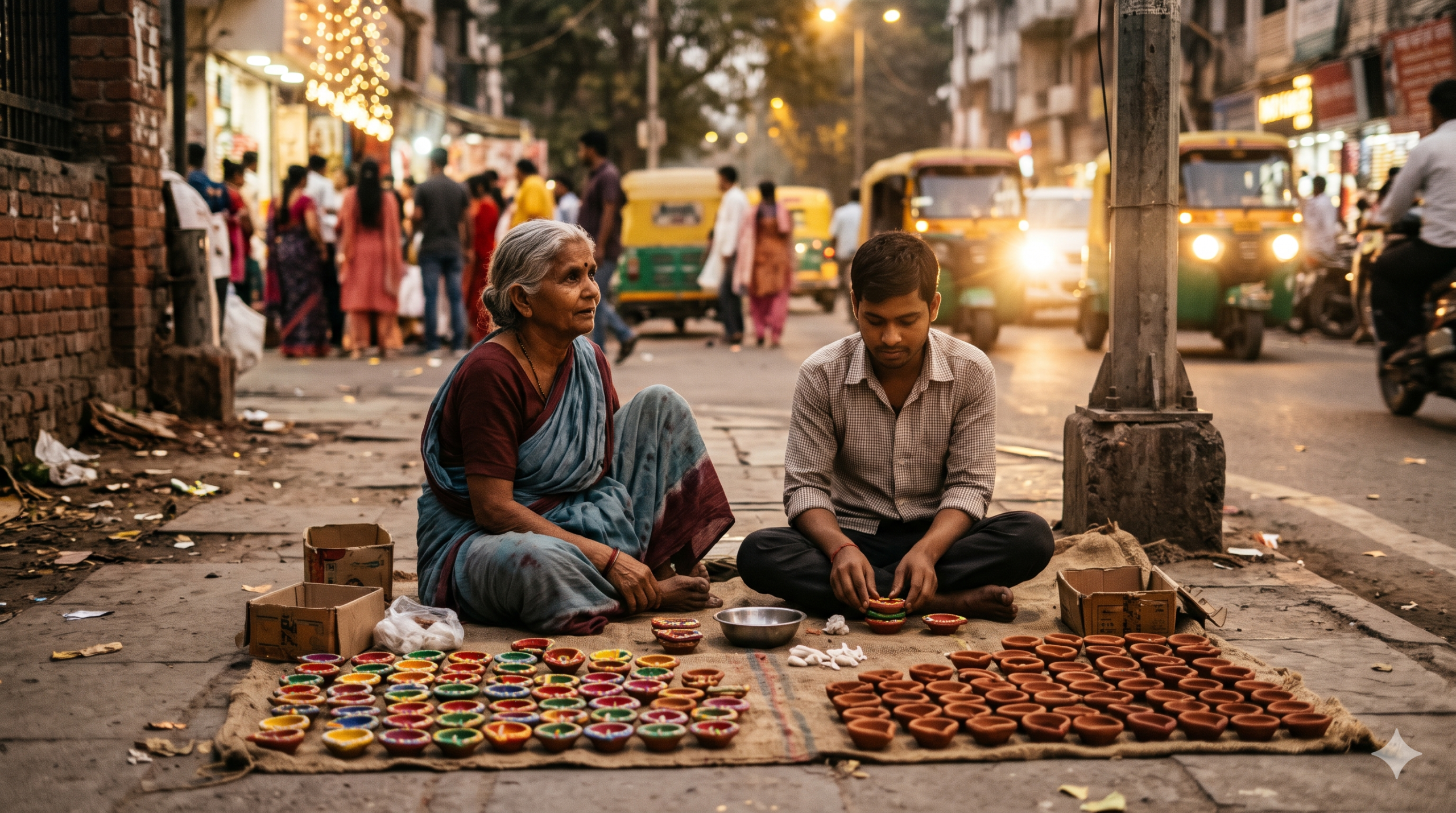
Across the road, seated on his haunches by the dusty pavement, was a young man surrounded by small mounds of designer clay diyas.I parked, crossed the road through the glare of headlights, and walked over. Up close, he looked to be in his late twenties, his lean frame carrying the wear of manual labor. Yet the moment our eyes met, his face broke into an unguarded, hesitant smile. There was an overwhelming innocence in his expression—an uncorrupted, gentle quality that made him seem far more like a young teenager than a grown man trying to make a living on the streets of Delhi.
“Bhaiya, kitne ka hai?” I asked, pointing to the painted clay pieces. In a sweet, feeble, almost kid-like voice, he looked up and answered, “Bhaiya, chalees rupaye ka ek piece.”Forty rupees a piece was steep. Just a couple of days earlier, similar decorative diyas were selling for twenty.
I fell instinctively into our everyday middle-class shopping reflex.
“Bees mein nahi toh tees mein de do. Do din pehle hi bees ka liya tha.”He blinked softly, looking down at the clay in his hands. There was no sharp retort, no aggressive haggling, no theatrical sigh about rising costs. He just traced the painted rim with a thumb powdered with fine mud and looked unsure of himself.”Theek hai bhaiya,” he whispered timidly. “Mummy se pooch ke batata hoon.”
I handed him a five-hundred-rupee note, asking for ten diyas. He took the note carefully with both hands and hurried off into a dimly lit lane behind the market.
A few minutes later, he walked back, leading an elderly woman. She wore a worn cotton saree, her face lined with the deep, quiet exhaustion of sitting through chilly autumn days on a curb, waiting for passersby to look down. In her hand was a small, faded cloth bag. Her son pointed at me, leaning in to whisper in her ear like a schoolboy waiting for his mother to solve a sum he couldn’t grasp.The mother looked at me, then down at the currency note in her son’s hand.
“Bhaiya, aapne mere bete ko paanch sau ka note de diya,” she said softly, her voice steady and matter-of-fact. “Isko yeh sab samajh nahi aata theek se. Dus diye toh sirf pachaas rupaye ke hain.”She unzipped the cloth pouch and began counting out notes to return the change. “Dus rupaye ka ek diya hai, aapne dus liye hain, toh aap bas pachaas rupaye de dijiye.”
A sudden ache hit my chest.
Standing in front of me was a mother and her son, navigating a harsh city. The boy clearly had a developmental challenge, seeing the world through a lens of unblemished innocence, completely unaware of how commerce works.
And the mother—tired, aging, and surviving on the margins—didn’t know how to calculate properly either.
Ten diyas at ten rupees each was a hundred, not fifty.In a world so quick to exploit naivety, I wondered how many buyers had quietly taken advantage of their confusion, walking away with extra change while patting themselves on the back for scoring a bargain.
“Pachaas nahi, sau rupaye bante hain,” I told her gently, explaining the math.She paused, looking up with genuine surprise, and folded her hands in a quiet thank-you. I pulled out another hundred-rupee note from my wallet and handed it to her along with the first. It wasn’t an act of charity.
Those diyas had been shaped on a wheel, carried across the city, and guarded on a freezing pavement for days. Their real worth was far greater than what she was charging out of sheer vulnerability.The way both their faces transformed will stay with me for a very long time.
The young man beamed, his eyes widening with pure delight, while his mother’s tired gaze softened with an unburdened, heartfelt relief. They thanked me again and again, their gratitude far outweighing the small gesture.
My wife and I talked about them all through that night.
We live in an era where we gladly pay platform convenience fees, surge pricing, and twenty-minute delivery premiums without blinking. We tip generously at air-conditioned cafes to look civilized, yet we instinctively haggle over ten rupees with the poorest hands on the pavement—people who carry our culture and ask only for fair bread in return.
The next evening, when we lit those ten clay diyas along our balcony, the flame burned a little brighter than the fairy lights.
They didn’t just hold oil and cotton wicks. They held the dignity of an honest mother, the sweetness of an innocent son, and a quiet reminder of what the festival of light is truly supposed to illuminate.
Happy Diwali 🪔
Vedant Khandelwal


